Kindergarten Reading Assessment: What to Test in September (Free Printable)
October 13, 2026
Download free PDF
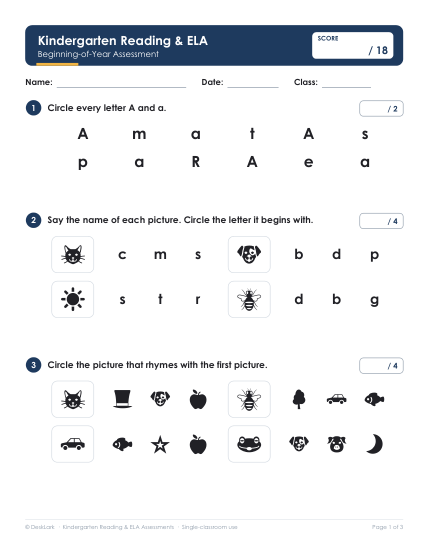
A kindergarten reading assessment given in September should tell you one thing clearly: which pre-reading skills each child already has, before you plan a single phonics lesson. The free test below has 7 items worth 18 points, takes 20-30 minutes in a small group, and comes with its answer key — download it, give it in the first weeks of school, and use the scoring guide below to group your class.
What the test covers
The 7 items sit across three reading domains plus writing:
- Reading: Foundational Skills (items 1-4 — 14 of the 18 points): recognizing uppercase and lowercase letters, beginning letter sounds, rhyming words, and counting syllables by clapping. This domain carries most of the score on purpose — it's the strongest predictor of early reading success.
- Reading: Literature (items 5-6 — 2 points): the teacher reads a short story aloud ("Sam and the Ball") and the child answers two questions about key details and characters.
- Writing (item 7 — 2 points): the child draws and writes to tell about a topic.
How to give it
Plan for 20-30 minutes per small group of 3-5 children, not the whole class at once. Read every direction and the read-aloud story to the children yourself — this is a test of reading-readiness skills, not of whether a 5-year-old can decode written instructions. For the "listen to the word" items, say the word that's circled in the answer key out loud before the child answers.
How to score it
Each item lists its point value next to the question. Partial credit applies: an item with four letter sounds to identify is worth 4 points, one point per correct letter. Add the 7 items for a score out of 18, then place it in a band:
- Mastered — 15 to 18 points. Ready for grade-level work; offer enrichment.
- Developing — 11 to 14 points. Mostly on track; reteach the weakest domain in small groups.
- Beginning — 0 to 10 points. Needs targeted support; plan intervention on the missed skills.
Because Foundational Skills carries 14 of the 18 points, a child who struggles there will usually land in "Developing" or "Beginning" even with a perfect score on the story questions — that's expected, and it's exactly the group to prioritize for daily letter-sound practice.
What to do with the results
Sort your class by their Foundational Skills score first; that's where the intervention time pays off most in kindergarten. A child who aces letters and sounds but struggles with the story questions usually needs more read-aloud time and discussion, not a different phonics approach. Keep the scored tests — giving the middle-of-year and end-of-year versions later and comparing the same domains shows whether the gap is closing.
Get the full assessment pack
This beginning-of-year test is one of three in the Kindergarten Reading & ELA Assessment Pack — it also includes a middle-of-year test (8 items, 21 points) and an end-of-year test (8 items, 28 points), each with its own answer key, a standards map, a 4-point writing rubric, a class tracker for up to 25 students, and a student progress snapshot. If you teach more than one grade, the K-5 Reading & ELA Assessment Bundle covers Kindergarten through 5th in one download.
More to explore
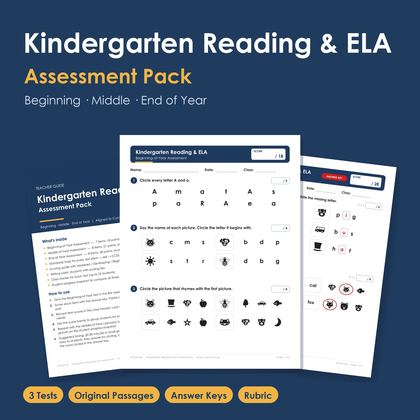
Kindergarten Reading & ELA Assessment Pack
Beginning, middle & end-of-year tests + answer keys + teacher guide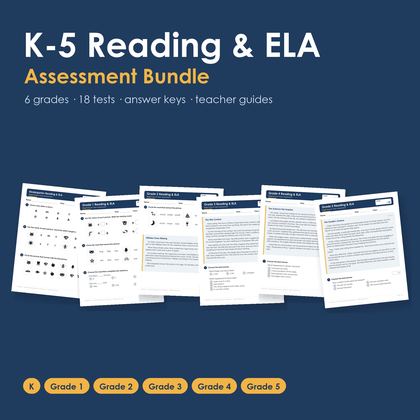
K-5 Reading & ELA Assessment Bundle
6 grade packs · 18 tests · answer keys · teacher toolsFAQ
How long does the kindergarten reading assessment take?
20-30 minutes, given in small groups of 3-5 children rather than the whole class at once.
Do I read the test to the children myself?
Yes. Read every direction and the short read-aloud story out loud — the test checks reading-readiness skills, not whether a kindergartner can read written instructions.
Is partial credit allowed?
Yes. Items with multiple parts (like identifying four letter sounds) award one point per correct part.
What if a child scores low only on the story questions?
That's a smaller part of the score (2 of 18 points). Focus intervention time on Foundational Skills first — letters, sounds, rhyming and syllables — since it carries most of the assessment.
Does the full pack include more than the beginning-of-year test?
Yes — it adds a middle-of-year and end-of-year test, a standards map, a writing rubric, a class tracker, and a student progress snapshot to track growth across the year.