Math Word Problems for Grade 2: Two-Step Problems (Free Printable)
Published October 24, 2026 · ⏱️ 2 min read · Printable Resource Guide
Download free PDF
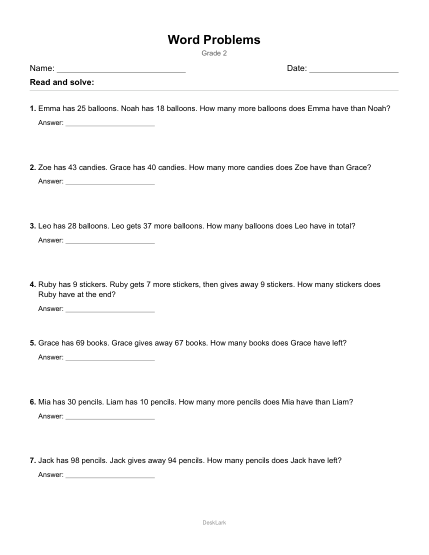
Grade 2 word problems move past "add these two numbers" into problems that take two steps to solve — a child has to work out not just the operation, but the order. The free worksheet below has 7 questions with an answer key; one of them (question 4) is a two-step problem, which is exactly the skill this grade adds.
What's in the worksheet
Most questions are straightforward comparison or combining problems:
- "Emma has 25 balloons. Noah has 18 balloons. How many more balloons does Emma have than Noah?" → 7 balloons (subtraction, comparing two amounts)
- "Leo has 28 balloons. Leo gets 37 more balloons. How many balloons does Leo have in total?" → 65 balloons (addition, combining)
But question 4 needs two steps instead of one: "Ruby has 9 stickers. Ruby gets 7 more stickers, then gives away 9 stickers. How many stickers does Ruby have at the end?" A child has to add first (9 + 7 = 16), then subtract (16 - 9 = 7) — skip either step and the answer is wrong even if the arithmetic itself is correct.
How to spot which operation a problem needs
The words "more than," "gets," and "in total" usually signal addition; "gives away," "left," and "how many more... than" usually signal subtraction. The trick with a two-step problem like question 4 is that it contains both kinds of language in the same sentence — "gets" (addition) followed by "gives away" (subtraction) — so a child who stops reading after the first clue and jumps straight to one operation will get a one-step answer to a two-step problem.
How to help with two-step problems specifically
Have your child underline each action in the story separately before writing any numbers down — in the Ruby example, that's "gets 7 more" and then "gives away 9," as two separate underlined phrases. Solve and write down the result after the first action (16 stickers) before even reading the second action again. Treating a two-step problem as "two one-step problems in a row" removes the part that actually trips kids up, which is holding both steps in their head at once.
Get the full bundle
This worksheet is one of three in the Grade 2 Word Problems Worksheets pack, mixing one-step and two-step problems the same way. If you want every grade from Kindergarten addition and subtraction through Grade 4 multiplication and division, the K-4 Word Problems Worksheets Bundle covers all five grade packs (15 worksheets total) in one download.
More to explore
Grade 2 Word Problems Worksheets — Two-Step Problems
3 worksheets + answer key · printable PDF
K–4 Word Problems Worksheets Bundle — 15 Printable Worksheets
5 grades · 15 worksheets · answer keys includedFAQ
What makes a word problem "two-step" instead of regular?
It requires two separate calculations in order — like adding first, then subtracting the result — instead of one operation applied once.
How can I tell my child is making a two-step mistake and not just a math mistake?
If they answer with the result of only the first action (16 instead of 7 in the Ruby example), that's a two-step miss, not an arithmetic error — the individual addition and subtraction were likely both correct on their own.
Are all 7 questions in the free worksheet two-step?
No — most are one-step comparison or combining problems; one question (Ruby's stickers) is two-step, which matches how Grade 2 typically mixes the two difficulty levels.
Does the full Grade 2 pack include more two-step problems?
Yes — the three worksheets in the pack mix one-step and two-step problems at a similar ratio to the free sample.
Is an answer key included?
Yes, every worksheet in the pack (and the free sample above) comes with a matching answer key.