Rhyming Words Worksheets for Grade 1 (Free PDF With Answers)
October 27, 2026
Download free PDF
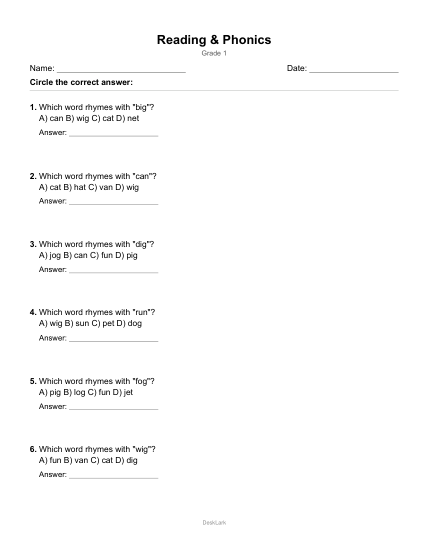
Rhyming is one of the clearest early signs that a child is hearing the sounds inside words, not just recognizing them by sight. The free worksheet below has 6 multiple-choice questions with an answer key — download it, then use the tips below if your child picks a word that looks similar instead of one that sounds similar.
Why rhyming matters
Rhyming asks a child to listen to the ending sound of a word and match it to another word, ignoring spelling and meaning entirely. It's one of the foundational phonological awareness skills that research links to later reading success — a child who can hear that "wig" and "pig" end the same way is building the same skill they'll need to sound out unfamiliar words.
What's in the worksheet
Each question gives a word and four answer choices; the child circles the one that rhymes. For example:
- Which word rhymes with "big"? A) can B) wig C) cat D) net — the answer is wig.
- Which word rhymes with "run"? A) wig B) sun C) pet D) dog — the answer is sun.
The six questions in the free download cover six different word families (-ig, -an, -un, -og among them), so a child practices the skill across several sound patterns rather than just one.
How to use it
Read each word out loud rather than letting a child read it silently — rhyming is a listening skill, and a child who struggles to decode the written word shouldn't be penalized for a reading gap on a rhyming test. Say the target word, then say all four answer choices slowly, stretching the ending sound a little ("biiig... caaan, wiiig, caaat, neeet").
If a child picks the wrong word
The most common mistake is choosing an answer that starts with the same letter as the target word instead of one that ends the same way — for instance picking "can" instead of "wig" when the word is "big," because "can" and "big" share no obvious link but a child guessing by sight sometimes grabs a familiar-looking word. If this happens, cover the first letter of each choice and say just the ending sound ("-ig") a few times before repeating the question; it isolates the part that actually matters for rhyming.
Get more practice
This worksheet is one of five in the Grade 1 Reading & Phonics Worksheets pack, with fresh word families and a matching answer key for each. If you want every grade from Kindergarten through Grade 4 — beginning sounds, rhyming, synonyms, antonyms and vocabulary in context — the K-4 Reading & Phonics Worksheets Bundle covers all five grade packs in one download.
More to explore
Grade 1 Reading & Phonics Worksheets — Rhyming Words
3 worksheets + answer key · printable PDF
K–4 Reading & Phonics Worksheets Bundle — 15 Printable Worksheets
5 grades · 15 worksheets · answer keys includedFAQ
What's a good first step if a child doesn't understand "rhyming" yet?
Model it with a few obvious pairs first (cat/hat, dog/log) and say "listen to the end of the word" before introducing the worksheet.
Should I let my child read the words themselves?
Read the words aloud instead. Rhyming is a listening skill, and reading the words silently turns it into a decoding test instead.
Why does my child keep picking the word that starts the same way?
That's the most common mix-up at this age — matching the first letter instead of the ending sound. Cover the first letter of each choice and repeat just the ending sound to help them focus on what rhymes actually depend on.
Is this worksheet multiple-choice or fill-in-the-blank?
Multiple-choice — each question gives four answer options, and the child circles the one that rhymes with the target word.
Does the full pack cover more than rhyming?
Yes — the Grade 1 Reading & Phonics pack includes five worksheets across different phonics skills, each with its own answer key.